 Europe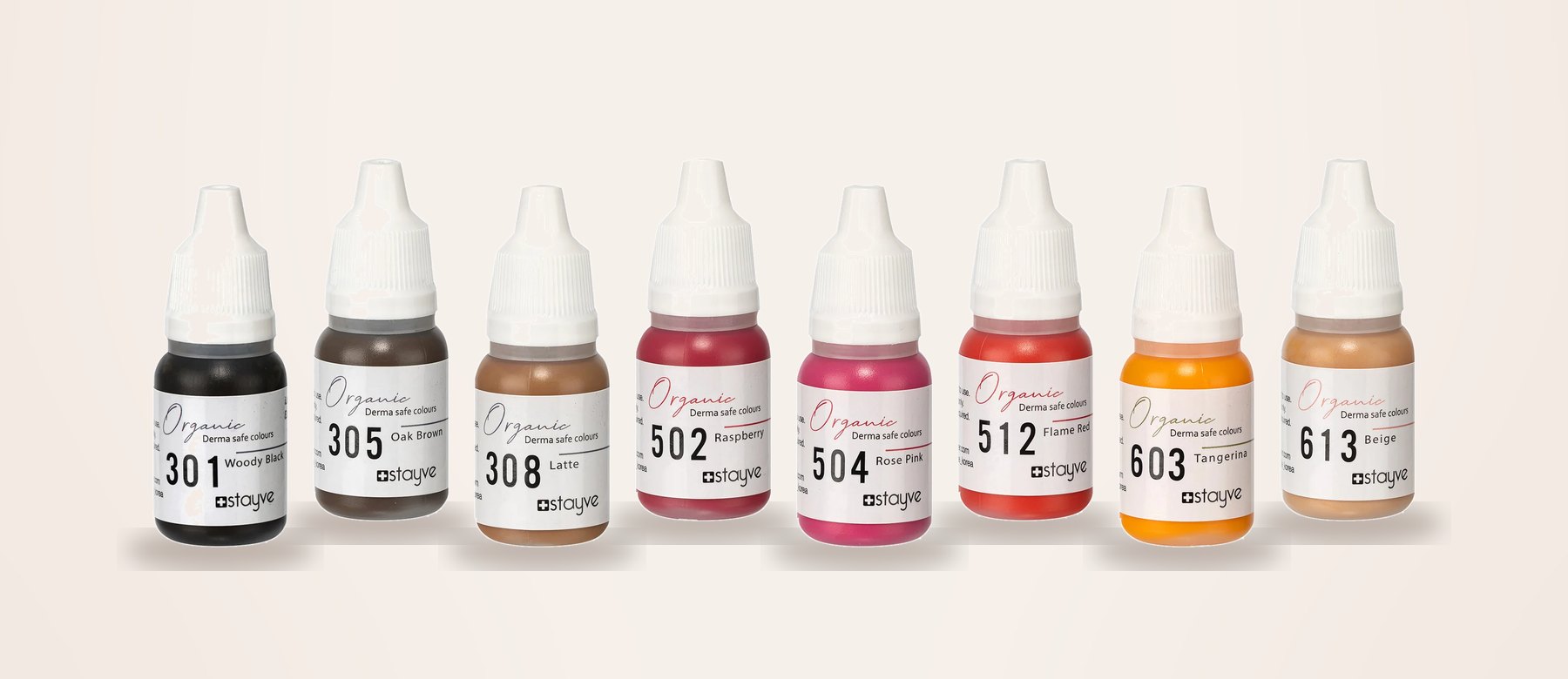
A working guide to the STAYVE organic pigment range
Twenty-nine pigments in six groups, and a cartridge system that assumes you know which technique you are about to perform — here is how the range is organised and how the pieces fit together.
What "organic pigment" means here
The manufacturer's catalogue makes a straightforward claim about the chemistry: organic pigments are brighter, stronger and much clearer in colour than inorganic pigments, and the STAYVE range is described as having a wide range of colours, vividness and excellent tint strength. The range is sold under the name Derma safe colours, in 10 ml bottles.
That is a claim about colour behaviour, not about longevity in a particular skin or about safety in a particular market. Before you sell or use any PMU pigment in the EU, the compliance question sits with the supplier, who should be able to show an EU REACH Annex XVII compliance statement and batch documentation for each pigment. Ask for them in writing; do not infer it from the fact that a product is on sale.
The six groups
The pigment range is organised by what the colour is for, not by how dark it is.
Eyeliner — one pigment
A single dedicated eyeliner colour: 201 Stayve Black, described by the manufacturer as giving a clear and vivid eye line with strong colouration and retention. One instruction on its documentation is easy to miss and worth following: do not use it on its own for eyebrows or the hairline. It is formulated for a line, not for hair strokes.
Eyebrows — eleven pigments
The largest group, described in the catalogue as covering various skin colours for men and women of all ages. The colours run from the darkest — 311 Midnight Gray and 301 Woody Black — through the chestnut and khaki browns (303, 304, 312) to the warm, light end: 306 Teddy Brown, 307 Ginger Bread, 308 Latte and 309 Honey Mellow. Each is described by reference to hair colour rather than by number, which is how brow artists actually choose.
Lips — eight pigments
Eight colours the catalogue describes as exclusively for lips, long-lasting and vivid, with excellent colouration and tint strength. They cover the cool-to-warm span: 501 Red Wine and 502 Raspberry at the deep end, 503 Magenta Red, 504 Rose Pink and 505 Barbie Pink through the pinks, and 511 Fiesta, 512 Flame Red and 513 Carrot Juice as the oranges.
Correction — four pigments
Four colours whose job, per the catalogue, is to adjust a colour's brightness or prevent discolouration. 601 Olive is green with a touch of yellow and 602 Taupe is yellow with a little green — the classic neutralisers for unwanted warmth in a healed brow. 603 Tangerina is a bright orange used to neutralise dark lips, and 604 Stayve White is an opaque white for mixing brighter colours.
Camouflage — four pigments
Four skin-toned colours for fine colour correction, wound cover and nipple cover: 611 Bubble Gum (beige with a pink hue), 612 Areola (a slightly dark beige with a yellow hue), 613 Beige (a basic beige of medium brightness) and 614 Camo (a toned-down pink beige). The manufacturer distinguishes 611 from 614 by calling 611 the pinker of the two.
Booster — one solution
701 Stayve Solution is a colourless solution that, according to the catalogue, acts as a booster: it adjusts colour density and increases tint strength. It is the lever when a colour is right but the concentration is not.
One stock note carried on the product pages: some colours may be unavailable due to current supply issues. Check before promising a client a specific number.
Cartridge choice by technique
The MISSMITO wireless machine takes both microneedling cartridges and semi-permanent ones. The catalogue names seven PMU cartridges and says what each is shaped for.
| Cartridge | Configuration | Catalogue's stated use |
|---|---|---|
| 1M | 1 prong micro | Delicate procedures |
| 1P | 1 prong | Eyeliner semi-permanent make-up |
| 2F | 2 prong flat | Lips — the delicate parts of the procedure |
| 4F | 4 prong flat | Lips — filling a spacious area |
| 3R | 3 prong round | Eyebrows — forms a triangular shape |
| 5R | 5 prong round | Eyebrows — forms a circle shape, used on a spacious area |
| 5S | 5 prong slope | Eyebrow embroidery methods with a machine — forms a sloped shape |
Read across the table and the logic is clear. Single-prong cartridges are for lines and detail: 1P for the eyeliner itself, 1M for the finest work anywhere. Flats are for lips, with 2F for the border and the corners and 4F for filling the body of the lip. Rounds are for brows, with 3R for controlled shape-building and 5R once you are covering ground. 5S is the one specifically named for machine brow embroidery.
The hardware rules are not negotiable. The catalogue states that MISSMITO's needles are not suitable for other brands of machines, and cartridges are single-use consumables. The machine itself weighs 0.10 kg, measures 16 cm, charges over USB-C and runs at eight adjustable speed stages; the catalogue also advises against using it above 220 V. The full machine and cartridge listing is under devices.
The brow techniques the catalogue names
On its organic pigment page the manufacturer illustrates four brow techniques, and the pigment range is positioned for all of them:
- Microblading — hair strokes cut with a manual blade, no machine.
- Ombré brows, manual tool — shading built by hand for a graduated brow.
- Ombré brows, machine — the same effect worked with the machine, which is where the round and slope cartridges earn their place.
- Nano brows — fine machine strokes, the technique that leans hardest on a single-prong cartridge and on pigment that stays clear as it heals.
The manufacturer's individual eyebrow pigment pages list microblading, ombré brows (manual tool or machine) and nano brows against the colours: the range is not split by technique, and the same eleven browns are intended across all four.
A note on lips, and on the other lip treatment
PMU lip pigment is not the only lip service in the catalogue. The Cherips set is a microneedling tint rather than semi-permanent make-up, and the manufacturer positions it explicitly against PMU: quicker to perform, gentler, and — its stated advantage — easy to change to a different colour later, where semi-permanent make-up makes a colour change difficult. For a client who wants colour but is not ready to commit, that is the conversation to have.
Whichever you offer, the aftercare shelf is the same: the Facial Treat line covers the repair step the manufacturer recommends after both semi-permanent make-up and microneedling work.